

New Year 2025 dawns with yet another issue of Samyukta Fiction – an open-themed one, once again, which allows us to draw in writers and translators from far and wide, bringing in many hues and many voices. In that spirit, it is my pleasure to present to you five new stories whose variety and style will surely appeal to you.

Our first story is “The Missing Man” by the distinguished Urdu fiction writer, poet, literary critic, and educationist Ghazanfar Ali. The former Director of the Academy of Professional Development of Urdu Medium Teachers at Jamia Millia Islamia, New Delhi, Prof. Ali, who goes by the name Ghazanfar, has held key editorial roles, including Chief Editor of Urdu Style Manual at the Central Institute of Indian Languages (CIIL), Mysore, under the Ministry of HRD, Government of India, and Editor of Tadrees Nama, an educational journal of APDUMT, JMI. A celebrated writer of sketches, Ghazanfar has written novels Pani, Divya Bani, and Manjhi, as well as the short story collections Hairat Farosh and Parking Area. He has been honoured with the National Eqbal Samman (2018) by the Government of Madhya Pradesh as well as Lifetime Achievement Awards from the Urdu Academies of Uttar Pradesh and Bihar.

The translator of the story Zainab Fatma holds a PhD in English Literature from Aligarh Muslim University. Her doctoral dissertation, titled “The City in the Literary Imagination: History, Memory, and the Present in Selected Narratives on Delh,i” concentrated on city narratives and memory studies. She has taught English Literature and Language at Aligarh Muslim University, Aligarh, and Jamia Millia Islamia, New Delhi. Her translations include works by renowned authors such as Ale Ahmad Suroor, Rasheed Ahmad Siddiqui, and Ghazanfar.
How wonderful it is, therefore, for Samyukta Fiction to be the home of the first English translation of his celebrated story “Missing Man” that first appeared in 2018 in Hairat Farosh. “The Missing Man” appears beguilingly simple: its central voice compresses in the bleat of a father the existential anguish of a man who looks back in despair at his entire life. Camusian in its resonance, this voice is the one the reader must go looking for. In Zainab Fatma’s limpid translation, the story comes to new life in the English language.
I have often had bouts of sadness while trying to keep my children happy. I have sacrificed my own desires and even crushed my ego. I wished they would understand what I go through, and that they ask about my unhappiness and express concern. Instead, they would always forget me while celebrating their victories over me.
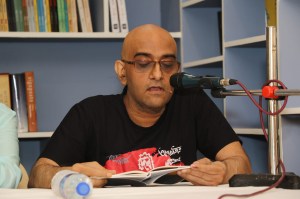
The next story is “Naxalite” by Hindol Bhattacharjee, a well-known name in Bengali poetry, and an award-winning poet and translator. A copywriter in advertising by profession, Hindol is the author of three essay collections, three short story collections, and three novels in Bangla. He has received the Paschimbanga Bangla Akademi (Anita Kumar Basu-Sunil Kumar Basu) Award, the Birendra Award, the Bhaskar Chakraborty Smriti Puraskar, and the Binay Majumdar Smarak Samman, among other honours. He is proficient in Bengali, English, and German and for the past 17 years, he has been translating German poetry into Bengali. Hindol’s story “Naxalite” is self-translated and first appeared as “Naxal” in Krittibas, March 2023.Stories about the Naxalite movement are not new in Bengali literature but Hindol trains a comic, satirical eye upon the theme and the story becomes at once something new and interesting for our contemporary time. As in Ghazanfar’s “Missing Man,” here too the voice of an elderly man looking back at the past appears as the faint echo of a momentous chapter of history that many would like to forget. Although Hindol captures this echo with comic spirit and the sharp point of satire, the story is a moving paean to the memory of idealistic men long lost in the abysses of darkness.
When the promoters’ harassment gradually decreased, everyone was surprised but not astonished, as they had already heard the ghost story. They had learned that the house was built on the graves of four young men who were murdered on that very land. However, they weren’t too afraid. And that’s when the story began.
Harshita Nanda’s “The Taste of Halwa Puri” is our next offering. Nanda is a writer, blogger, and book reviewer based in Dubai, UAE. She trained as an engineer before changing tracks to become a full-time writer. She was one of the shortlisted candidates for the Rama Mehta Writing Grant, 2023, and her short stories have found a home in many anthologies such as The Blogchatter Book Of Thrillers, The Blogchatter Book of Love, and Lightning Strikes, An Anthology of Flash Fiction by Indian Writers. Her stories have also appeared on web journals such as Kitaab, Porch Lit Mag and Roi Faineant Literary Press. “The Taste of Halwa Puri” builds a heart-warming tale of women’s interrelationships, complicated by social structures and patriarchal values, but also fully capable of subverting outdated mores when women so choose. The story’s portrayal of intergenerational bonds that can both constrict and uplift allows us to see the value of friendship between women, especially between mothers and daughters.

The blue flames danced as she turned on the stove. Placing an iron wok on top, she filled it halfway with oil. As the oil heated, she rolled out the dough for puris. Even though it had been years since she made them, Gayathri’s hands remembered what she had learnt in the kitchen of her ancestral house.

Ranjita Biswas’s “The Shoes” is our next story. Biswas is a prize-winning short story and children’s fiction writer who has been by published by Ranjita Biswas’s “The Shoes” is our next story. Biswas is a prize-winning short story and children’s fiction writer who has been by published by Children’s Book Trust, National Book Trust, Mango Books, among others. She is an independent journalist and translator of fiction from Assamese. An award-winning translator, Biswas has won the KATHA Translation awards thrice. Biswas’s translations of Assamese writer Arupa Patangia Kalita have been especially successful, garnering her the Sahitya Akademi Best Translation Prize in English (2017) for her translation of Kalita’s Assamese novel Written in Tears and the PFC-Valley of Words award in 2021 for her translation of Kalita’s short story collection The Loneliness of Hira Barua. Kalita’s Dawn translated by Biswas was published by Kali for Women/Zubaan and was also translated into Hindi. An anthology of contemporary Assamese stories that she has edited is scheduled for publication early this year. We are delighted to feature Biswas’s short story “The Shoes,” which maps the changing tides of social class mobility in contemporary India. A benign spirit pervades the story as we follow the horizons of a young working-class woman whose dreams and aspirations transform in the era of Viksit Bharat.
In her village she was known as the horin because she could run so fast, fleet like a deer, and barefoot too. When she played with her friends in the field, she used to outrun all the other girls. Sometimes, they climbed the mango trees in the garden of the rich farmer…
Our final story is the deceptively titled “Love Story?” by Priyanka Sarkar. Priyanka is an editor, translator, and writer. She has translated Mrinal Pande’s Sahela Re (HarperCollins 2023), Shivani’s Bhairavi (Yoda Press and Simon & Schuster 2020) and Chitra Mudgal’s Giligadu (Niyogi Books 2019). Sarkar’s translations of short stories from Hindi to English have appeared in anthologies published by Yoda Press, OUP India, Women Unlimited, South Asian Review, and Macmillan. Her translations have also featured on Scroll.in and Audible.
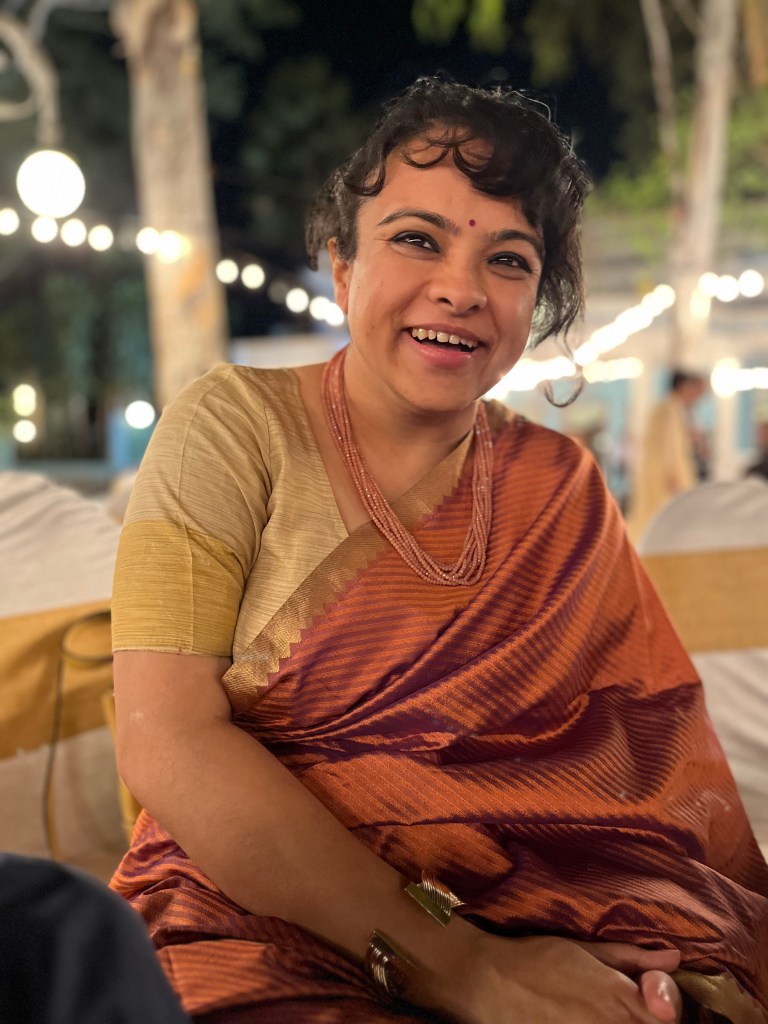
A short story written by her has appeared in Sahitya Akademi’s Indian Literature. As an editor, she has worked with OUP (Assistant Editor) and Random House India (Managing Editor). She was also the head of Editorial at Konark Publishers Pvt Ltd. She currently freelances and is associated with the Rama Mehta Writing Grant, which aims to encourage creativity in English, Hindi, Urdu and Rajasthani among unpublished Rajasthani women writers. She is also associated with the Bangalore-based writer’s residency, Sangam House. She is the Translations Editor (Prose) at The Bombay Literary Magazine and was on the Literature Live! 2024 Literary Awards Jury for Fiction Book of the Year and Fiction First Book.
“Love Story?” is a sly tale slyly told – enjoy its surprise, and its fun, frolicky vibe. Sarkar’s prose captures the yuppie subculture, laying bare its compensations and contradictions as seen from the perspective of a young man negotiating masculine values in an urban milieu – you may have met many like him or you may be him, who knows!
Akash took a bracing, long gulp from his cocktail, hoping he looked pensive rather than someone in need of liquid courage. Then, clearing his throat, he said, ‘Actually, it isn’t that publishing is in a bad shape per se because the market is bad. The real reason is that the right kind of books are not being picked up.’
And that, as they say, is a wrap! Happy New Year, Samyukta Fiction readers. I hope 2025 brings you many wonderful stories, to write as well as to read. Happy reading!

 SAMYUKTA FICTION