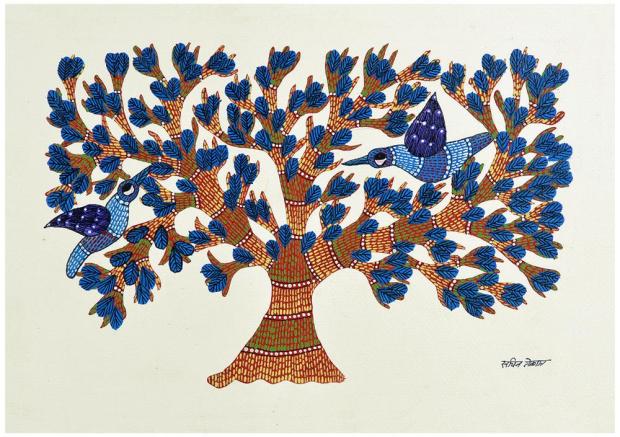
An Afternoon

Srijoni Banerjee

Bimal realized that his past ailment had started bothering him again. A collector had come knocking at his door after several months, her face half-covered in a mask. The pandemic had begun to recede slowly. Bimal greeted her and offered a few drops of hand sanitizer. That was then followed by other rituals to make her feel welcome. Previously, guests would be first greeted with a glass of water, followed by tea and some sweets, but the pandemic changed everything. Isabel, from Spain, in her sixties, sat stiffly, sifting through Bimal’s paintings. 

His paintings have always been a blend of very bright colours, a bit unusual because the way he uses his palette is quite different from other artists. This is not his own opinion. Eminent critics have said so in several reviews. His canvas has always been a ferment of bright hues. There came a time, however, when he started losing colour. Almost twelve years ago, after his transfer to the steel foundry, colours started to fade. One’s job always affects one’s lifestyle and even one’s mind. His job was always at odds with his creative side. He was at the same time an artist and a worker in a locomotive factory. However, the new surroundings in the foundry were completely incompatible with his temperament. 

Continue reading
Reload

Soumyajyoti Mukherjee

The club was lit as usual with brightly coloured lamps and strobe lights, yet, it was barely visible to K, who could not see their colours with his grayscale vision. The photoreceptors of his optical sensors picked up the light and used that to make visible what he was focussing on, but colours were out of his remit. 

As he sat on the stuffed high back chair of the booth, K barely managed to stop himself from gritting his pearly-white teeth while he waited. Stacked up chairs and tables littered one corner of the room and the digital infrared code of the ‘Emergency Exit’ sign straight ahead pinged his sensors. 

The wall clock struck another hour off the day as Bobby, sitting opposite to him on the booth, snapped the end cap of a cigarillo, blatantly ignoring the ‘No Smoking’ sign above the bar to the right, and let out a puff of smoke that K could only sense by the ping of his sensors as they highlighted a potential hazard, and  an unpleasant smell of the synthetic tobacco that suddenly filled the booth.

Bobby, an old contact of the resistance and owner of the club, was part of an exclusive circle of humans who had no qualms about dealing with the resistance, as long as they were paid. Bobby’s circle conducted business with both sides and stayed out of the way. Strict neutrality was the order of business — which meant one never knew whether a deal one made with him would be compromised by a deal someone else made with him.

For obvious reasons, the resistance only used Bobby when they had no other choice.

Continue reading

An Ancestor in the Classroom

Sreya M. Datta

I want this to be a story about a spirit in the shape of words. Stay with me, and you will know what this means by the end. 

**

It begins with an assignment on “decolonizing literary practice.” We are tired students, working day and night to beat the pandemic fatigue and chase that elusive first class for our Masters degree in Global Literatures. Most of us are sleepy from having only recently enjoyed the comforts of home during the pandemic and being able to complete part of our course online. Some of us are grieving. Now we are back. Like waves against a shore, our goings and comings are inexorable. 

At every bend, we are reminded that it is a privilege to study about the world within the secure walls of an esteemed First World university. India, Africa, Canada, Jamaica —nothing, no part of the world is beyond our reach. Sometimes, they throw in British and American literatures too, to show that postcolonialism is a complex discourse, not bound by the mere accident of geography. We attend all our classes religiously because our visas depend on it. We cannot miss too many, otherwise this country will shut its doors on us. No one wants to waste an opportunity like this. Our presence sustains an entire ecosystem—the University thrives on our fees, landlords rely on our rent, our enterprise boosts the flagging economy. We are in a symbiotic relationship, we are wanted here.  

We ring home sometimes when we are not too busy cooking dal in smuggled pressure cookers. A cooker added two kilos to the twenty-three that we are allowed by the international airlines. In the larger scheme of things, its weight is a small price to pay for all the nourishment we receive. On some evenings, I also prepare a friendly smile in case my neighbour passes me by the hallway and says, “are you cooking dal? Smells divine. Makes me want to cook some myself this evening!” For you, I want to say, it will take forty-five minutes and a lot of stirring. I say nothing because you collect my mail sometimes, when I am away at University. I do not want to upset the delicate balance of conviviality I have built up painstakingly. I collect hallway encounters like airport embraces. Somehow, I convince myself, they will all help me survive in this land.

Continue reading

In the Yard

Geetha Ganapathy-Doré

“Is it your cat that is meowing at such a high pitch so early in the morning? What is happening?”

“Oh, Frimousse just saw the packet of Friskies in the neighbour’s house and got super excited. Let me take her away from here so that you can work in peace,” said Aurore.

Marie looked out of the window and saw the grey clouds gathering in the horizon despite the shaft of sunlight that fell on the terrace. She will have to finish the report for the university and press the “send” button before it starts raining and her mood becomes rotten.

It had been nearly a year for her, working from home due to the pandemic. As she had not closed the windows, she could hear the news floating in from the neighbour’s TV.

Cats have been found to have been infected with the coronavirus giving rise to speculation that some patients might have caught the infection from their pets.”

“Well, I must remember to clean the windowsills with sanitizing wipes hereafter. The cat plays there,” Marie told herself and got back to her keyboard.

She tried to concentrate and get her work done. When she looked up again, it was already half past twelve. She switched on her television and started washing some lettuce to make some salad for lunch.

Three experts were being interviewed in an outdoor setting. It is clear the virus jumped from the animal to the human, which animal is the question. Is it the bat or the pangolin?

Continue reading

Red

Sofia Amir

 You are looking at a painting. Medium: oil. Size – relatively large, an appropriate frame for pristine historicals, for portraits of kings, conquerors, maybe a god or two. The pigments are monotone, warm, mostly reds, hints of browns, greys, blacks. 

 It is the reds that aptly tell the story.

It isn’t clear to you what the painting is about. It sits in a corner of the museum, away from the noise of the its travelling exhibition that had stumbled into town at the end of the year without a trackable name, a head or a leader, someone to take the pamphlet up to and question why the artworks have no name, why this wing in particular is devoid of art that complements its tones, its mood, why there is no plaque or sign that might make decoding it easier, might provide some solid footing, because the painting is neither one thing nor the other.

 It is an abstract, and it isn’t; there is an attempt at establishing a landscape. 

Continue reading

Black

Dhee Sankar

You wore green that day. No, actually you wore many colours at once, I wrote green just because one has to start somewhere. You wore green like the time you first told me devastating things about yourself. Of course you don’t remember, why would you, it was nine years ago! You liked that dress a lot, didn’t you? Bright, blinding green, the kind of green parrots wear. Do you still have it? Is it yours, or did you inherit it from someone? I like to think you bought it just for yourself, that its young cotton body has never known any other body but yours, and it sleeps somewhere in your wardrobe blessed with the peace of belonging to you alone. But I digress. 

Continue reading

Blue

Chiranthi Rajapakse

This is how the tourist brochures describe it: “A beautiful island with blue skies.”

When you live here you don’t look for the blue in the sky every morning. You look for grey, for blue tinged with the heaviness of cloud, you look for signs that the day will not be one of unremitting, ceaseless sun, that it will not be a day perfect for sitting by the sea, but a dull, overcast day good for walking – walking and standing and waiting in a place where waiting has become a part of life. 

You wake at five. At that time the power cuts haven’t kicked in. There is tea but no milk because milk powder disappeared from the shops a while ago. You use a wood fire now because you have run out of gas and supply has been erratic for weeks. You remember how the blue flame used to emerge when you switched on the gas cooker and how you took it for granted then. 

Continue reading

Marigold

Malini Roy

                     Lopa—short for Lopamudra—bent forward to place the petri dish of live cells on the mechanical stage of the light microscope, not spilling a single drop of the nutrient liquid.    

                     It was evening and her eyes were already red from the exertions of the day; and once she had switched on the light switch of the microscope, her eyes hurt even more. She looked in through the eye piece of the microscope. But all she could see was a blur akin to sunset. She began turning the screws that would adjust the height of the stage of the microscope. And then Lopa began to focus the objective lens upon the petri dish, finally obtaining an image both sharp and clear. 

                     The cells were wiggling around in the dish. The largest cell was positioned almost in the middle, with a nucleus bloated out at the centre rather like a flower’s receptacle. Lopa screwed up her eyes and observed this one. It appeared to have arms radiating outwards, like the firelit petals of a French marigold soused in wind and rain. And the adjoining cells were a shade of honey, flecked here and there in the yellow of a Tuscan sun, deepening into a scarlet glow towards the right end of the petri dish.   

Continue reading

Dancefish on the Banks of the Yamuna

Ashwarya Samkaria

1.

This is a tale of a young Odissi dancer, a fish, a literary ecologist, and water bodies. On the surface level, all of them are separate entities. But by the end of the story, you will realise how tangled-up everything is. As earthlings, the dancer and the literary critic were steeped in the world of arts. Their apparently divergent practices (one pertaining to bodily movement and the other to linguistic diversity) were quite interlocked. The elder sister Ayesha, training as an ecocritic, was a person of letters studying nature from a literary perspective. Her world was enmeshed in studying the interconnectedness between nature and culture. The younger sister Shirin was participating in the world as an ‘Indian classical Odissi dancer’, a label that was constructed by the cultural revivalists under the aegis of cultural institutions established in independent India post 1947. She derived inspiration for movement in an aesthetic and corporeal language from the natural world that was home to humans, nonhumans, and more-than-human elements. Her dance teemed with images of the earth and earthlings who were re-presented through the dancing body’s movements- as living creatures that moved and participated in the oneness that unites all living and nonliving beings. In their different ways, the siblings were weaving their lives around nature and the environment. The difference was the threads with which their narratives were being woven. 

Continue reading

Mother

Tathagata Som

Every morning, after tea, I water my mother. I water her even in the monsoon when it rains incessantly and the trees do not need more water. It has become a sort of ritual at this point. She stands still in the garden outside, uncomplaining, as lonely as she was when she lived inside the house and spent days looking forward to when I would return from college and while away time with her. The very thought now fills me with guilt and shame. Perhaps I steadfastly water her as a form of penance, hoping that the water will cleanse me of my sins. Now, she stands outside my study window and waves her branches in the breeze. Even when there is no wind, the chirping of birds that live on her branches informs me that my mother is alive and well. On winter nights, I hear her shivering, but I can hardly do anything about it. Once, I tried to light a fire under her, near where her roots dug deep into the earth, but it started to burn the low-hanging leaves, so I had to put it out. She is happiest on spring mornings. I can almost hear her laugh when the first sun shines through her bright leaves and bees dance around her. My mother is as beautiful as when she lived inside the house, in human form. I sometimes look at her pictures—old photographs from her college years when she went to the University of Calcutta—and wonder at her beauty. I can almost understand how my father fell head-over-heels in love with her. There is a photo where she is standing in front of a bookstall at College Street, dressed in a churidar, her long dark hair flowing like a mountain stream. She is not looking at the camera, but sideways at another person who is left out of the frame. Behind her stands my father, his hair wavy, his face placid with a large moustache. He is wearing large-framed sunglasses so I cannot see his eyes. It was taken two years before I was born, one year before their marriage, and nine years before father’s death. 

Continue reading