
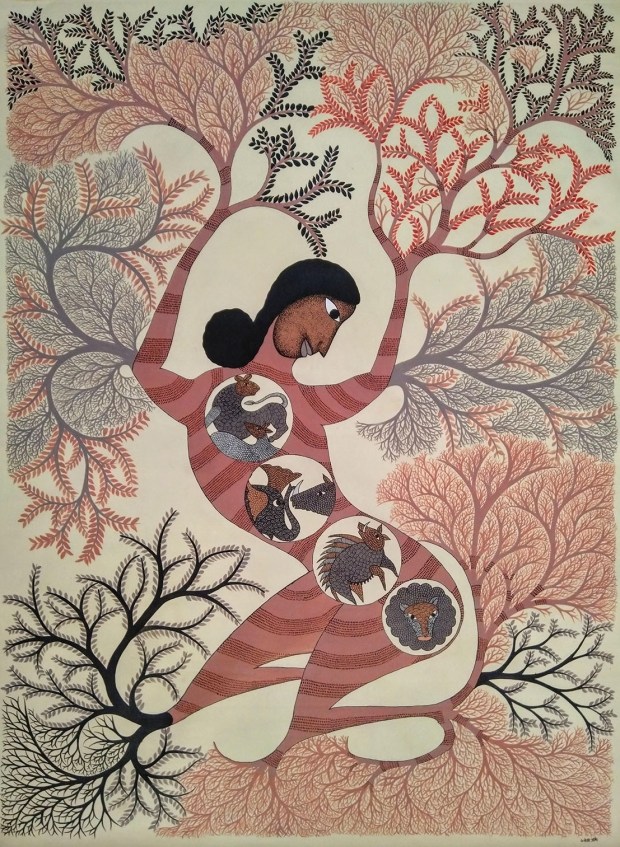
Waldeinsamkeit
Chitra Gopalakrishnan
A mild June sun sprawls outward in a pale yellow fan of light against the sky in the village of Satoli in the Kumaon hills of the northern Indian state of Uttarakhand.
Now and then, liquid sunshine casts a translucent light on the elevated, snow-clad, Himalayan mountain ranges and lingers over the peaks of Chaukhamba, Trishul, Nanda Devi, Sunanda Devi, and Panchachuli and then abruptly plays truant. When it does, these giants turn, within moments, into shadowy, grim sentinels guarding the horizon. Then just as suddenly when the sunbeams open out again, this time shining through marshmallow clouds, they distract these flinty mountains out of their cold, stony disposition.
The effect of this manoeuvre on me is magical: a floating sky with drifting peaks of silver gleams its way right into my heart.
Yet it seems to me the sun is wilfully keeping much of its story, much of its savagery, its hibiscus-red cruelties, tucked within these milky-white billows. I know of such obliqueness. Of such peculiar ambivalences. Of such guardedness to full disclosure. Of how to be a pale reflection of one’s true self.
I know it well. Inside out.
After all, my every day, natural world spaces are not the same as the essential part of me, my inner core. While I will leave the uncovering of my inner enigmas for later, let me, instead, say for now that I am on a reverse journey, a coming back to my origins, to the region around which I was born and grew up, a place with its lights and half-lights, to its luminous mysteries as also its familiarities, that hold an elemental allure in my mind, the same giddy spark that moved me as a child in sinew and spirit.
In this low morning light, I am out on a walk in the forest close to the Satoli village covered with lichen for miles, one that I have known as a child. Around me, everything is misty, wet and heavy and my face is slick with mist spray.
I have been told by a clairvoyant that in the place of my birth and in between the trees of this forest will be my doorway to a new world. Foolish, misplaced faith in a misleading science, you may exclaim. And what a rash and reckless thing for a woman to do, you may rebuke. Foolish, female flâneuse, I can almost hear you say, sauntering in the jungle as if it were sanitised city streets, rummaging through its dark corners, peering behind its façades, going where she is not supposed to go. But I have decided to take my chance with my clairvoyant’s illogic; logic, reason and counselling having yielded no answers all these years.
As I enter the forest, the fuzziness around makes the moss-veiled pine, chestnut, rhododendron, and oak trees look like glistening, bottle-green ghosts as their crowns flicker with bleached sunlight. I see the pine trees oozing amber crusts of resin on their barks that catch the straying sunlight, in a manner that makes them look like rheumy-eyed, glowing ghosts.
I plod alone along the wood-incensed trail. I notice that the raucous langurs and rhesus monkeys prefer to line trees that bear hisalus, petite golden-yellow Himalayan raspberries, box berries called kafals, and plums. Sun or no sun, they cause a clamour all around. The branches of these trees thrash about with their rivalry, their collective hysteria. The bird songs are replaced by bird cries. And the air comes alive forcefully to the fragrance of ripened berry droppings, one that quickly turns sickly sweet.
I pass the modest shrine of Gorakhnath, the deity of the hills, set beneath a huge horse chestnut tree. On its stone-hewn steps sits a chunky, sardonic-looking, ridiculously smelly cat. As it squats amidst the tree’s fallen white candyfloss flowers, with hooded eyeballs, a stretched-out sinewy tail and with a cool, dry and balanced exterior, a naïve trekker must be forgiven for the impression of it being in a yogic trance. In reality, it lies in wait of the jays, drongos, mynas, parakeets, and wingtails that seek the tree’s shadows.
I spot a solitary, prowling red fox drive it away. The tomcat leaves with reluctance on its stumpy legs, virulently meowing, hissing, with its claws out. Its curled contemptuous lip, its piratical tilt of the head, and its long backward walk is an indication that today’s fight might be lost but the outcome of the war is yet to be determined. A porcupine takes this chance to waddle up and feast on fallen nuts from the tree. It is joined by an unruly band of fleshy mountain squirrels. I see everything.
As I walk deeper and deeper into the forest, into areas I am wholly unfamiliar with, I become keenly aware of the green gradient within its interiority. Of looking into all manner of greens, where one shade of green insidiously blends into another, till my consciousness is trapped in a green blur. The grass is forest-green, the creepers parakeet-green, the lichens olive-green, shrubs of wild garlic and basil chartreuse-green, the water within mud puddles moss-green, the slimy, bulgy-eyed frogs’ a lurid, neon-green and the undersides of the Himalayan barbets, that fly in a group with a rush of wings, an assortment of green tints.
Over the hours, the forest lures me into its liminal corners, to its furthest parts, to its innermost places removed from everyday existence, to where sunlight sieves through only certain branches, to where the rare, spongy, honeycombed morel mushrooms grow and to where a loose band of twelve goat antelopes, the ghorals as they are known here, fuss about as they forage for food and mates.
As I approach the ghorals, with what I assume to be soft, steady, muted footsteps, their barks turn to snorts of alarm, sharp and high in tenor. I instinctively know they have been watching me for long, testing me, my intent. Exactly how long their wide-eyed vigil has lasted I am unclear but I see with dismay their tan legs and grey-brown coats disappear into the twilight and hear the receding sounds of their hoofs.
The minute I see them run I wish I could do the same. This adventure of mine seems ludicrous at this moment. In this instant, I am wild with fright, unnerved by my risky presumption, my attempt to rewrite my own fate by changing my setting. I would think exposing myself to vulnerability like the ghorals should feel like courage, except it does not. Fear washes over me, my skin leaps and my stomach twists. Excitement mixed with fear makes for a ghastly goulash. I am ridden with a sinking feeling. One that tells me my foolhardy experiment is bound to fail before it begins.
I feel the forest size me up. Perhaps, to see if I am up to Waldeinsamkeit. Roughly translated from German, it means the feeling of being alone in the woods. It is a feeling that comes over you when you are at peace with the forest, or in your environment, or with yourself.
It was my German school teacher, Hannah Schneider, who had explained this concept to me years ago, in her fluid, crystalline prose. Her luminous classes at my convent school in Nainital moulded my young, impressionable mind and her explanation of the idea stayed with me over the years like a thing one always knew about oneself but never really spoke about. I recall her saying that whoever learns to speak to trees, listens to them can learn life’s deepest truths. And her caution against missing the forest for the trees. If you see in fragments, you will think in fragments, she had said.
Will I able to reach my reach my Waldeinsamkeit, the wonderful state of equipoise that my teacher spoke of? Will I be able to slip into a state of calm, intuitive functionality even as the forest’s disasters fall on me, sometimes in spite and malice, other times by accident and whim? I wonder even as I hear the receding sounds of the ghoral’s barks.
I have come here to test precisely this. I need to know whether I will hold up not only to the treacheries of the forest but to the extremities of life, its contradictions. As a person, as a woman, if I do, the jigsaw puzzle of my life could come together. Perhaps.
I look through the canopies of the trees as the sun begins to crumble and the apertures of light begin to narrow. There is a change in the colour of my opaque environs. Everything turns into a shade of midnight green, a damp, dense midnight green. The vegetation takes on a measured, indistinguishable, dark hue and the forest keeps up with the stillness in the atmosphere. It reminds me of an artful painter’s solid, consistent brushstrokes, both in depth and shading, the attempt to work up towards a metaphor of stability.
The bird songs grow faint and a quiet settles with the darkness. It is an elemental silence like the stillness of ice. But the silence is not an easy one. The chill wind on the trees sounds like a drawn-out hiss. It cuts my skin like a knife. And the forest is sullen, taut and braced like a nocturnal predator as if to resist some sudden attack from outside.
As I stand uncertainly, feeling idiotic, wanting to escape back into the world of cities and taxis and coffee, I am equally responsive to a shiver of mingled anticipation that sets in. I give in to the latter. I succumb to a deep inside need to be caught by something in the wilderness. To be set upon. To be made to see my own darkness, the extent and the horror of my malevolence, the deepest of my deeps. To be shown up for what I really am.
All my life the only way I have known how to fight the darkness is to be the darkness. I thought I could lose my dread of demons and devils within me by being them. As I crouch, here and now, away from the world, with half my soul taken away, I want to know there is another way to face my enemy within. Of what I am truly frightened of. To discover a new enormity, a way to live with myself.
I know this fight is one to regain my soul.
Twelve years ago, in my early thirties, I was pinned to the bottom of existence in love or, should I say, an extra-marital affair. The man was an unbearable egotist, as well as a liar who would neither leave me nor his wife.
As I thrashed and struggled to get free of our fractured intimacies, I could only swim towards the surface of life and protect my own sense of self-worth by destroying him and his life’s work. He was a painter. It was easy to set fire to his studio without ever being found out—an electric short circuit was all it took, and easier still to anonymously mail his wife two years later and tell her about the string of women in his life to trample his marriage, his life, under my foot.
If what I inflicted on him had ended here, I could perhaps have found some reprieve, a way to forgive myself. But my lover committed suicide unable to bear the destruction and ignominy, the black upheaval I had created in his life. No one suspected me of being an abettor to his suicide but his gaunt, weary face haunted me in my dreams. I found myself staring at him every night, one fearful eye to another. And as his gaze prowled my skin and as hour passed into hour, my cowardice began to sweat itself out.
I imagined the incident of his suicide in flaming detail and countlessly replayed it in my mind, night and day. The natural order of my life stood disrupted. The smell of my fear and shame, raging in its intensity, became hard for me to bear. Whom had I avenged? Whose destruction had I set into motion?
I felt I had no place to hide and could not make space and time for other people or life itself and I fitted myself into emptiness as an escape. To me it felt like the loneliness of a hundred births was compounded into my present life. I knew I was hurtling into an abyss, into bottomless despair, but ironically also towards an ending.
I have wanted to free myself of this evil, cut it away in a clean slice, but it lives on within, smouldering, disembodied, and coils around my soul, consuming it, its substance.
My solitary foray into the forest is my self-wrought punishment to arrive at my blackness, accept the emptiness I have created and coalesce with it. Hah! My best friend Sheela ridicules this inquiry of mine as my death wish, as my capricious disregard of personal safety and well-being and the result of my inability to handle my reality. Not that she knows my real truths! No one does. I enfold into myself this vast sky of shame, as vast as this forest, as unremitting, as unforgiving.
The wraith-like silver disc of the moon, hanging lonely in the sky and shivering down to a shard, takes me to the forest pond. I assume it to be the run-off gathering from the nearby Gaula river. I don’t resist its lead and choose to sit at the pond’s edge, on a moss-buffed boulder that feels damp, spongy. The trees around peer into its ripples and though I don’t touch the water, I know it is ice-cold. Night seeps through the ground to spread from tree to tree gathering them in a mass of darkness.
Audible over the silence of the forest are the clicks of cicadas, the skittish noises of aphids, the chittering of woodworms beneath the gnarled roots of trees wedged by the pool and the crunch of dry, fallen leaves beneath my feet.
But most of all, I am aware of the lonely rhythm of the water, its swishes, clunks, swells, and clops, as it washes over cobbles, pebbles, gravel, and silt, and the muffled sounds of the many submerged denizens of the deep. Phytoplankton, zooplankton, cold water fish, I dimly recall my old school lessons. This is what the sunken aquatic ecosystem must have, this is what the murk and slither beneath is all about, I think. My nostrils inhale the heavy scent of weeds.
I spot two ruddy shelducks hurriedly tip themselves into the far end of the pond and then just as quickly fly away. Were they here to lay eggs in this abandoned place at night? Or am I imagining things? I hear rustlings. Is it a soft-footed leopard? I wonder. A dire picture of it plunging its jaws into me, into my ripped-open belly, with malicious merriment, even as my limbs flay about, imprints itself in my mind. I struggle to adjust to such contraries, real and imagined.
What I don’t imagine in the next moments but certainly feel, or should I rather say experience, with clarity, at the edge of the pond, is a peculiar force at work. Something soft and yielding with a lyrical appeal that makes this space not so threatening anymore but a congenial and safe one, infused with a limitless energy that is both alluvial and aquatic. I fit myself into its spaciousness and my fears drain themselves out.
The pervading energy brings me to a point of unbearable expectancy where I am vividly present to myself, to my whole self, the good and the bad parts, my qualities and my defects, past and present. As I am to the reality of the jungle, I see its ineluctable laws that support both life and death, good and evil in the same measure.
In this balance of contrarieties, where everything is real, everything is true, everything is just as it is, I experience oneness with the universe, the falling away of the hierarchy of a creator and the created and the false dichotomy of good and evil.
I know it will be difficult for me to corral this experience into words, impossible even; it comes to me that good and evil are not two mutually exclusive entities but two different functions of life and I realise that all possible conditions or states of existence reside within life at each moment.
The forest has spoken to me. It has made sense of my incomprehensible situation with a simple yet potent message. It has helped me negotiate my self-doubt, my anxiety, my shameful feeling of being out of step: it has returned me my soul. I feel confident that the days that follow will birth new skies. And that Frau Schneider is smiling from above, her spectacles and grey hair glinting with approval.
As daylight breaks, I, who am now without boundaries and an extension of everything around me, feel joy and wonder. My clairvoyant was right about the forest being the gateway to the falling away of all that I was before. It is indeed a place for epiphanies. I intend to not to fight or fix yesterday but build and grow something new. Going back to my beginnings has taught me that there is always room for a new idea, a new step, a new start.
The forest has given me my Waldeinsamkeit. Even in its darkness. Or maybe in its darkness.

 SAMYUKTA FICTION